

By Sameer Khanna · Updated June 13, 2026
Plenty of rummy guides walk you through the cards and stop there — which is exactly why beginners keep declaring hands that look finished and still drop points. The cards are the easy part. Knowing what actually counts as a valid hand is where the real money is won or lost.
The ok rummy rules are quick to state and easy to get wrong: arrange all 13 of your cards into valid sequences and sets, hold at least one pure sequence with no Joker in it, then declare before anyone else does. New accounts get a ₹41 bonus with no deposit, and cash play starts at just ₹25.
Key Takeaways
- You win a hand by sorting all 13 cards into valid sequences (3+ consecutive cards of one suit) and sets (3+ cards of the same rank), with at least one pure sequence.
- A pure sequence cannot use a Joker — declare without one and the system scores you as if you held your entire hand.
- OkRummy runs six rummy formats: Points, Pool (51 and 101), Deals, Gin, Tournaments, and the private Salon Room.
- The ₹41 signup bonus needs no deposit, the minimum deposit is ₹25, and UPI withdrawals from ₹100 clear in under two hours in most cases.
- Rummy has been treated as a game of skill — not gambling — by the Supreme Court of India since 1968, which is why cash play is legal across most states.
Why new players lose hands they should have won
Here is the pattern I see again and again with people who’ve just installed the app. They learn what a sequence is, they sort their cards into neat little groups, they hit declare — and then the result screen hands them a points penalty they didn’t see coming.
The problem almost never lies in the cards themselves. It’s the validation rule underneath them. Rummy doesn’t reward a hand that looks organised; it rewards a hand that meets two strict conditions at once, and most beginners only internalise one of them before they start playing for cash.
So before any strategy talk, get the structure right. Once the ok rummy rules below stop feeling like a checklist and start feeling automatic, the rest of the game is just patience and reading discards.
Ok Rummy rules: sets, sequences, and the pure-run trap
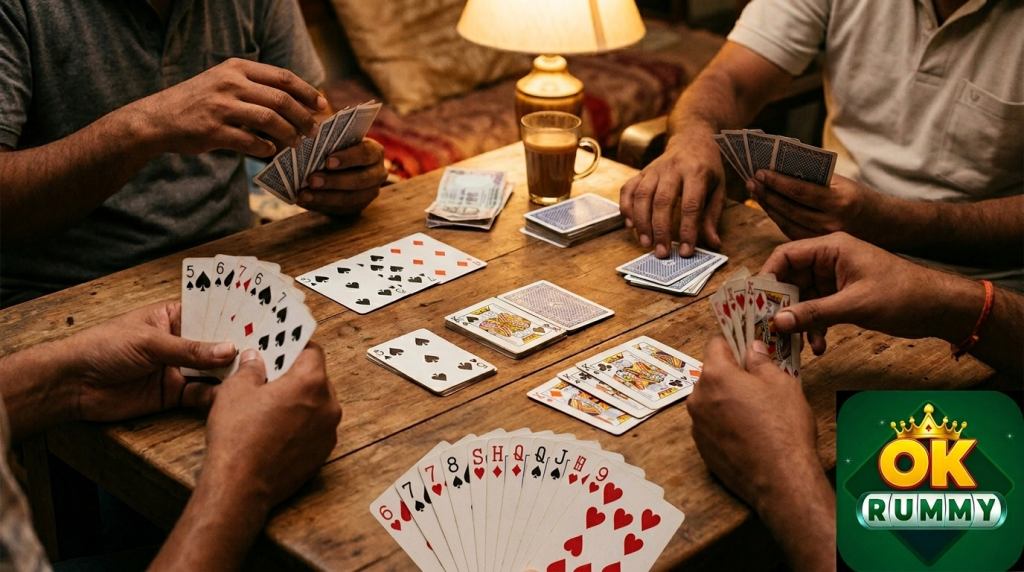
Every hand begins the same way. You’re dealt 13 cards, and your job is to break all 13 into valid groups before your opponents manage it.
There are exactly two kinds of valid group. A sequence is three or more consecutive cards of the same suit — 6-7-8 of spades, for instance. A set is three or more cards of the same rank pulled from different suits, like three Queens. Simple enough on paper.
Now the rule that quietly decides most games: you need at least one pure sequence before a declaration is even legal. Pure means a run with no Joker filling a gap — three actual consecutive cards of one suit. The Joker is generous everywhere else; it can stand in for any missing card in a set or in a second, impure sequence. But it is not allowed in that first pure run, and that single restriction is what catches people. Declare without a pure sequence and OkRummy penalises you as though you never melded a single card.
On your turn the loop is short. Draw one card, decide whether it improves your hand, discard one. Repeat until your full hand resolves cleanly into sequences and sets — then declare. Bottom line: two valid groups, one of them a Joker-free run, and you have to be first. Everything past that is refinement.
What a wrong declaration actually costs you
This is the part marketing pages skip, and it’s the part that matters most to your bankroll. An invalid declaration isn’t a harmless do-over.
When you declare a hand that breaks the ok rummy rules — missing pure sequence, an incomplete group, a miscounted set — the game treats your entire hand as unmatched. In Points Rummy that means you’re charged the maximum points (capped at 80) multiplied by the point value of that table. On a ₹2-per-point table, one careless declaration can cost ₹160 in a deal that should have been a small loss or even a win.
I watched a friend do exactly this on his second evening with the app — declared a clean-looking hand built around two impure sequences, no pure run, and lost a full deal’s maximum because of it. The cards were fine. The rule wasn’t followed. That’s the difference the result screen actually punishes.
The fix is a five-second habit. Before you tap declare, find your pure sequence first and confirm it’s Joker-free, then check the rest. Do that every single time and invalid declarations basically stop happening.
Six formats, and which one to learn on
OkRummy doesn’t run one version of rummy — it runs six, and they differ mainly in how scoring and elimination work, not in the core ok rummy rules you just read.
- Points Rummy — a single quick deal where every point carries a rupee value, settled the moment someone declares. It’s the fastest format to learn, and the one I’d steer any beginner toward first.
- Pool Rummy (51 and 101) — you’re knocked out once your accumulated score crosses the pool limit. The 51-point pool ends quicker; the 101-point version is a longer grind that leaves more room to recover from a bad deal.
- Deals Rummy — a fixed number of deals with equal starting chips, and the biggest stack at the end takes it. The cost is predictable up front, which is why cautious players tend to like it.
- Gin Rummy — a leaner two-player variant with its own scoring quirks. Worth trying once the sequence-and-set logic is second nature, not before.
- Tournaments — multi-round knockout events with weekly guaranteed prize pools climbing up to ₹10 Lakh. High variance, and not where a new player should start.
- Salon Room — private themed tables for playing with a group you choose rather than random opponents.
If you take one thing from this section: stay on low-stake Points Rummy until your declarations are clean every time. The other five formats are the same game wearing different stakes structures. Learn the cards, then pick the format that suits your bankroll — not the other way round.
Getting from download to your first hand
Setup is genuinely fast — under five minutes from download to a live table, in most cases. Here’s the sequence, with the caveats affiliate pages usually leave out.
- Install the app. The APK is roughly 45MB and needs Android 5.0 or newer. You can Download OkRummy Free from the official source. Android will ask you to allow “Install from unknown sources” — standard for any app that isn’t on the Play Store, not a warning sign.
- Register and verify. Enter your mobile number, confirm the OTP. About a minute.
- Claim the ₹41 bonus. It lands automatically — no deposit, no card details, no wagering hoop to clear first. When I set up a fresh account to check this, the ₹41 was sitting in the wallet before I’d finished choosing a username.
- Add cash only if you want higher stakes. Minimum deposit is ₹25, and UPI, Paytm, PhonePe, and bank transfer all work. You can play purely on the bonus to start if you’d rather not deposit yet.
- Join a table. Open the rummy lobby, pick Points Rummy at the lowest stake, and sit down. From there it’s draw, arrange, discard, declare.
One troubleshooting note, since it’s the most common snag: if a deposit doesn’t show instantly, don’t pay twice. UPI confirmations occasionally lag a few minutes — give it five, and only then contact support with the transaction reference if it still hasn’t landed.
Where OkRummy earns its keep — and where it doesn’t
A fair assessment means naming both sides. On withdrawals, the platform holds up: a ₹100 minimum, UPI cash-outs that clear in under two hours in most cases, and KYC verification that ran in about 25 minutes when I submitted documents. That said, this speed mainly applies to UPI — bank-transfer timelines can stretch toward 24 hours depending on your bank.
The trust signals check out for the category, too. Gameplay runs on RNG-certified card distribution, transactions sit behind SSL 256-bit encryption, and the platform claims over 1 crore registered players. None of that guarantees you win — skill games never work that way — but it does mean the deal you’re dealt is random rather than rigged against you.
The honest caveat is the breadth. Beyond rummy, OkRummy bundles Yono-style games — Ludo, Poker, Crash, Dragon Tiger, Andar Bahar, Wingo, 7 Up Down, Jhandi Munda, and Roulette. Some of those are luck-driven rounds with no skill edge to grind, and it’s easy for a beginner to wander in and burn the ₹41 bonus on them. Rummy itself is the skill game, protected as such by the Supreme Court of India’s 1968 ruling that classed it as a game of skill rather than gambling. Treat the casino-style titles as entertainment between hands, not as a strategy.
So who is this actually for? If you want to learn rummy properly, cash out fast, and start with money the app hands you rather than money you risk, the entry cost here is about as low as it gets. Learn the ok rummy rules around that pure sequence, practise on Points tables, and when you’re ready to play your first real hand, Play OkRummy Now and put the ₹41 to work.
Common questions about playing OkRummy
Do the Ok Rummy rules allow a Joker in my pure sequence?
No. A pure sequence must be three or more consecutive cards of the same suit with no Joker substituting. The Joker is only allowed in sets and in a second, impure sequence — never in the run that makes your declaration valid.
How much do I need to start playing for real cash?
The ₹41 signup bonus lets you play without depositing at all. If you want to add your own money, the minimum deposit is ₹25, and you can withdraw winnings from ₹100.
Is playing rummy for money legal in India?
In most states, yes — rummy has been recognised as a game of skill by the Supreme Court since 1968. A few states restrict real-money play regardless, so it’s worth checking your own state’s rules before you deposit.
Which format should a complete beginner choose?
Points Rummy. It’s a single deal, settles instantly, and lets you practise the sequence-and-set logic without the longer commitment of Pool or Deals formats.